Stop Adopting AI
AI adoption is rising faster than enterprise value because companies keep installing new intelligence inside old operating models.
AI adoption is rising faster than enterprise value because companies keep installing new intelligence inside old operating models.
There is a familiar AI meeting happening inside large companies right now. The CEO wants the business to become “AI-first.” The CIO can show a rising number of licenses, the innovation team has a portfolio of pilots, HR has launched AI literacy training, and every function has been asked for use cases. There is movement everywhere, but it is much harder to answer a simpler question: what important business outcome is now materially better because of all this AI?
The gap is becoming difficult to ignore. McKinsey’s 2026 global survey found that 80 percent of respondents say AI has improved their individual productivity, while only 37 percent attribute any EBIT impact to their organization’s use of it. Just 6 percent qualify as AI high performers, essentially unchanged from 2025.[^1] Deloitte found a similar structural problem: 48 percent of organizations had introduced AI without redesigning the workflows or roles around it, while only 12 percent reported redesign at scale with a new operating model behind it.[^2]
The technology is spreading faster than the organization is changing.
That is not an adoption problem. It is the consequence of treating adoption as transformation.
You adopt a tool. You transform a business. Confusing the two is how companies end up with more AI and almost the same company.
Adoption is the wrong unit of change
Licenses, monthly active users, prompts, copilots deployed and hours saved are useful operating metrics for a software rollout. They are weak transformation metrics because they measure whether people touched the technology, not whether the system of work changed.
A company can reach impressive adoption numbers while preserving almost everything that made the old process expensive in the first place. A six-step process becomes a faster six-step process. A report nobody needs is generated in seconds. A manager gets an AI summary of the meeting that should not have happened. A customer-service agent writes a better response while still navigating three systems and two approvals to solve a simple problem.
The mistake is not automation. It is choosing the tool or task as the unit of change when the economically meaningful unit is usually larger.
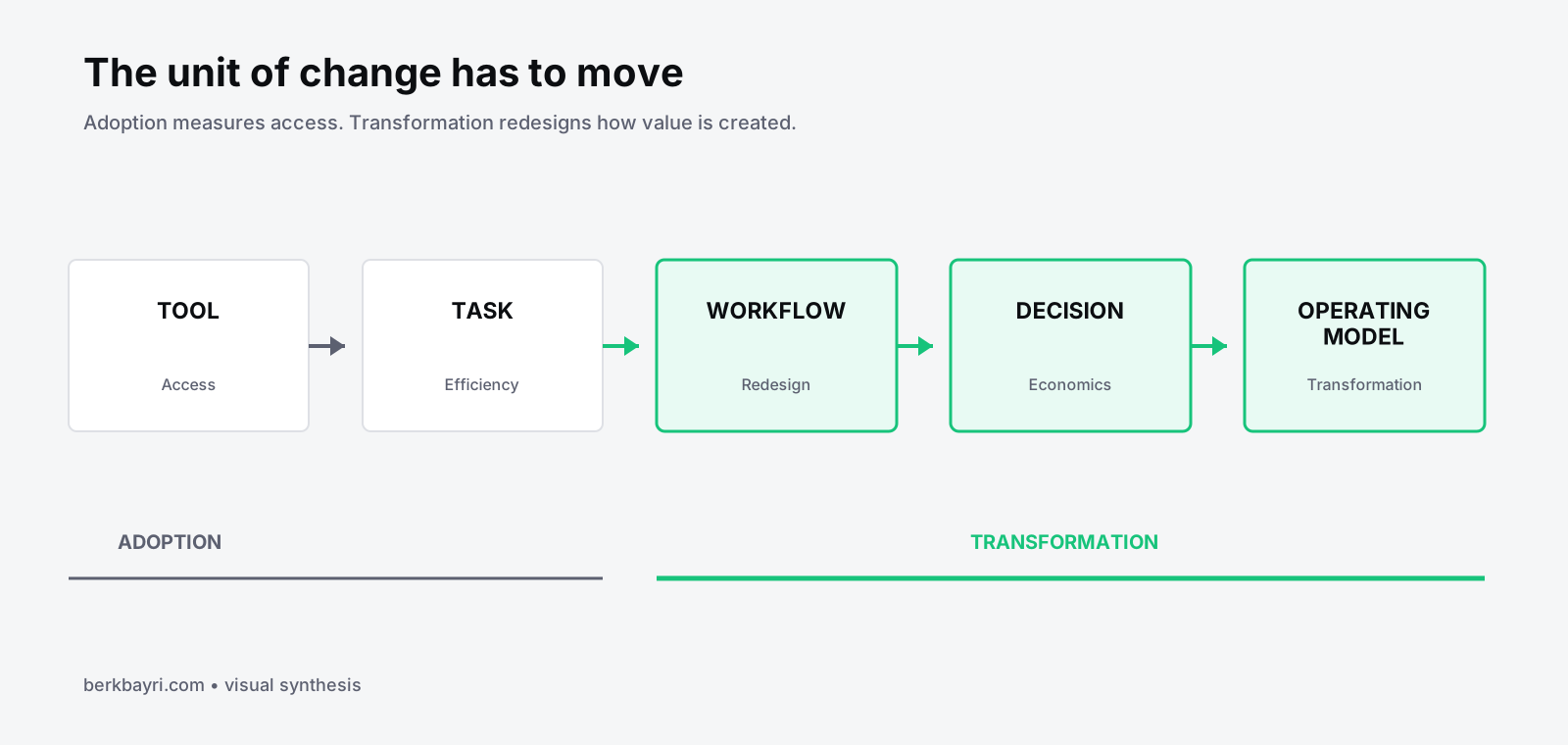
Stanford’s 2026 Enterprise AI Playbook, based on 51 successful deployments across 41 organizations, reinforces the point. Seventy-seven percent of the hardest implementation challenges were not model problems but change management, data quality and process redesign; 61 percent of successful projects included at least one prior failed attempt.[^3] The technology mattered, but the expensive part was making the organization capable of using it differently.
Do not automate the mess
Most companies were not designed for cheap, abundant machine intelligence. Their workflows reflect older constraints: information moves from person to person because systems do not talk; managers review work because visibility and trust are poor; functions maintain separate data because ownership follows organizational boundaries; approvals accumulate because nobody wants to own the downside of a decision.
Adding AI on top of this architecture can make the absurdity more efficient without making it less absurd.
The more valuable question is therefore not, “Where can we insert AI?” It is, “If we were designing this workflow today, knowing intelligence is cheap and increasingly actionable, which steps would still exist?”
That question changes the conversation. If five people approve a decision nobody truly owns, an agent that prepares the approval pack is not the breakthrough. If a customer complaint must travel across three teams before anyone has the authority to resolve it, a faster response generator is not transformation. AI should remove organizational debt, not automate it.
This is why workflow redesign shows up repeatedly among stronger performers. McKinsey reports that high-performing organizations are much more likely than others to fundamentally redesign workflows around AI rather than merely improve isolated tasks.[^1] Deloitte’s 2026 agentic-AI research makes the same gap visible from another angle: only 5 percent of organizations described their business processes as highly prepared for AI agents, and just 15 percent had reached scaled, orchestrated cross-functional multi-agent adoption.[^4]
Productivity is not value until something changes downstream
The most seductive AI metric is time saved. It is easy to understand, easy to survey and almost always makes the technology look useful. A proposal that took two hours now takes twenty minutes; an analyst can summarize a hundred documents before lunch; a developer ships code faster.
But saved time has no automatic economic value. It only becomes valuable when the organization changes what happens next.
If a person saves five hours a week but their goals, headcount plan, decision rights, workflow and output expectations stay the same, the business may capture very little of that capacity. Individual productivity and enterprise economics are connected by a conversion mechanism, not by magic.
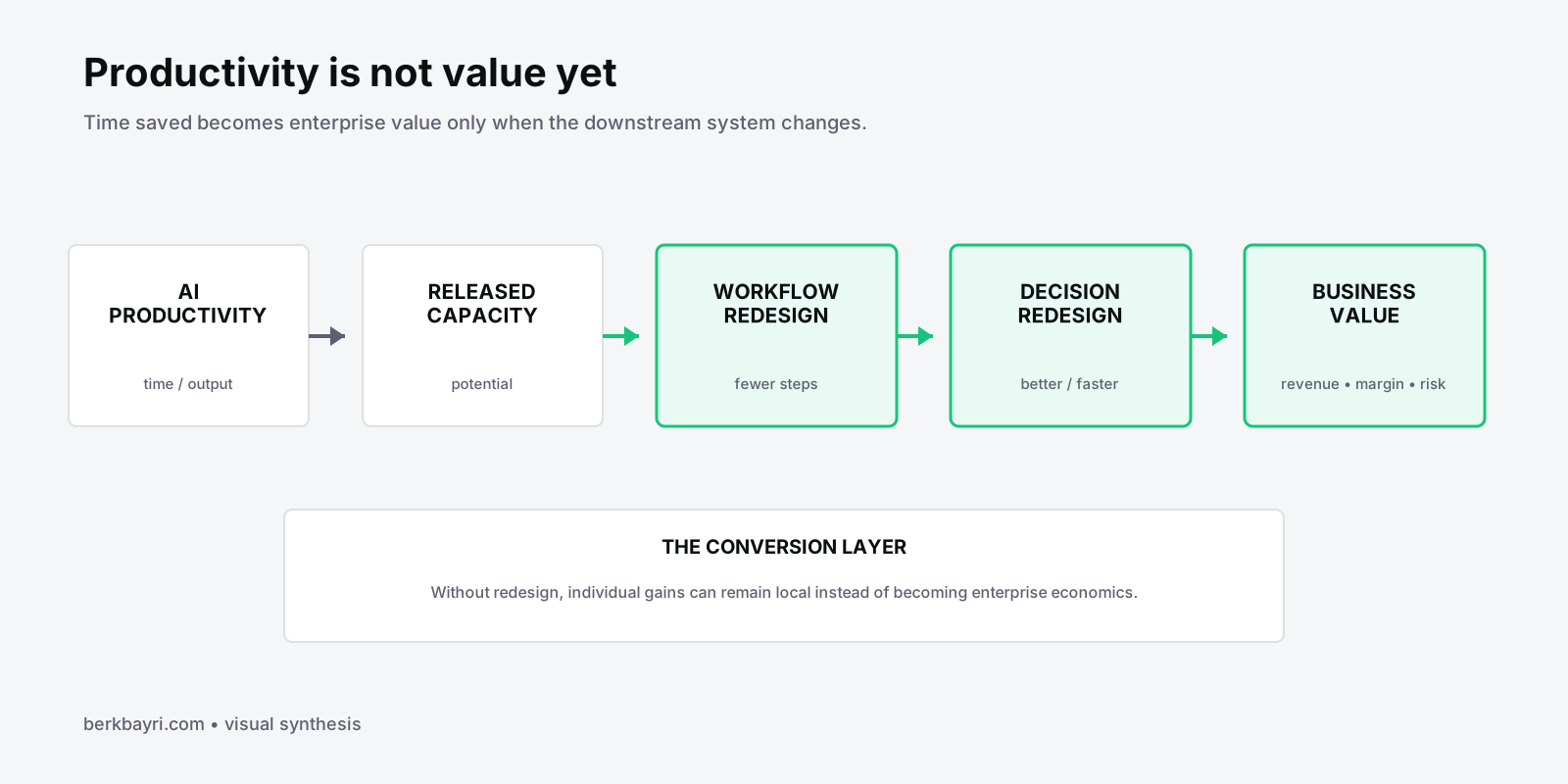
This is the significance of the 80-percent-versus-37-percent gap. It does not show that AI productivity is fake; it shows that productivity is upstream of value. The organization still has to decide what to do with the capacity, how to redesign the workflow around it, which decisions can now move faster, and what economic outcome should change.
McKinsey’s recent work on the “decision dividend” points in the same direction: some of AI’s largest gains may come not from labor savings alone but from faster decisions, better asset use and opportunities that would otherwise have been missed.[^5]
That suggests a better starting rule for enterprise AI:
Start with the valuable decision
Do not begin with the model, vendor or use-case workshop. Begin with a valuable decision or workflow. Identify who owns it, how long it takes, what information it depends on, where judgment matters, and what delay, error or inconsistency costs the business. Then ask what changes economically if that decision becomes dramatically faster, continuously available or materially better.
If those questions have no answer, there is no AI business case yet. There is a demo.
Your employees may not be the bottleneck
Companies often frame AI adoption as a people problem: employees need more training, better prompting skills, more confidence or more willingness to experiment. Some of that is real. It is also convenient, because it moves responsibility down the organization.
Microsoft’s 2026 Work Trend Index surveyed 20,000 AI users across ten countries and found that only 26 percent said leadership was clearly and consistently aligned on AI. Forty-five percent said it felt safer to focus on current goals than to redesign work with AI, and only 13 percent said they were rewarded for reinventing work even when the experiment did not immediately meet its targets.[^6]
That creates a strange corporate bargain: employees are told to reinvent their work while being measured by the rules of the old work.
A prompt-engineering workshop cannot solve that. Neither can another internal ambassador program. If budgets still follow functions rather than outcomes, if experimentation creates career risk, if managers reward visible busyness, if legal and security arrive only at the end, and if nobody has permission to remove obsolete work, the company is teaching people to use AI while structurally preventing them from changing anything important.
The employee is not always resisting AI. Often, the organization is resisting what AI makes the employee capable of changing.
Stop worshipping the model
The same category error appears in technology strategy. Executives spend large amounts of time deciding which foundation model should become the corporate standard, as if the winning model were the durable source of advantage.
Sometimes model choice matters. Often it matters less than procurement processes imply.
In Stanford’s successful-deployment sample, the foundation model was considered fully interchangeable in 42 percent of implementations.[^3] What proved harder to copy was the orchestration around it: proprietary context, integrations, workflow design, evaluation, feedback loops, decision rights and the organizational capability to keep adapting as models change.
The model is rented intelligence.
The company still has to design the system that turns intelligence into differentiated action.
This becomes even more important with agents. Once AI systems can take actions rather than merely generate text, governance can no longer sit at the end of the hallway as a committee that approves or blocks finished projects. Authority becomes part of the architecture: what the system can see, decide and execute; when it must escalate; what gets logged; who owns failure; and how quickly the system can be rolled back.
Good governance is not the opposite of speed. It is what allows more consequential automation to move safely.
The real transformation is the company
AI is becoming an uncomfortable mirror because it exposes organizational problems that were easier to accept when they looked like normal corporate life. Poorly documented processes become automation failures. Fragmented data becomes visible. Slow decision rights become measurable. Managers who mainly move information between people become easier to question. Meetings built for coordination begin competing with systems that coordinate continuously.
This is why an AI strategy that begins with AI is usually starting one level too low.
Start with the business outcome. Map the workflow and the decisions that create it. Remove the work that no longer needs to exist. Decide what machines should do, what humans should do and where one must supervise or challenge the other. Change the incentives and metrics around the new system. Measure cycle time, decision quality, customer outcomes, revenue, margin, risk and capacity — not merely licenses, prompts and pilots. Only then choose the technology.
The sequence matters because AI does not transform companies by entering them. Companies transform when they reorganize around what AI has made newly possible.
The companies that get this wrong will have more AI every quarter: more licenses, more agents, more pilots, more generated content and more dashboards celebrating adoption, while yesterday’s organization simply runs faster.
The companies that get it right may eventually talk about AI less. The technology will disappear into the way the business works while workflows shorten, decisions improve, roles change, new economics emerge and old assumptions quietly die.
That is what transformation looks like.
Not more AI. A different company.
Sources
url: https://www.deloitte.com/us/en/what-we-do/capabilities/applied-artificial-intelligence/blogs/pulse-check-series-latest-ai-developments/ai-transformation-predictions-2026.html title: Enterprise AI trends 2026: AI transformation strategy publisher: Deloitte date: 2026
Get new essays as they publish.
One email per essay. No noise between.
Berk Bayri
Creative Technology & Innovation Leader
Designing and building for digital environments since 1998, across strategy, product, design, technology and organizational innovation.