AI agents are exposing your org chart as fiction
An org chart tells you who manages whom. An agent can reveal who actually authorizes a decision, rescues an exception, and carries the consequences.
The hierarchy can be perfectly accurate about who reports to whom and still tell you almost nothing about how a consequential decision gets made.
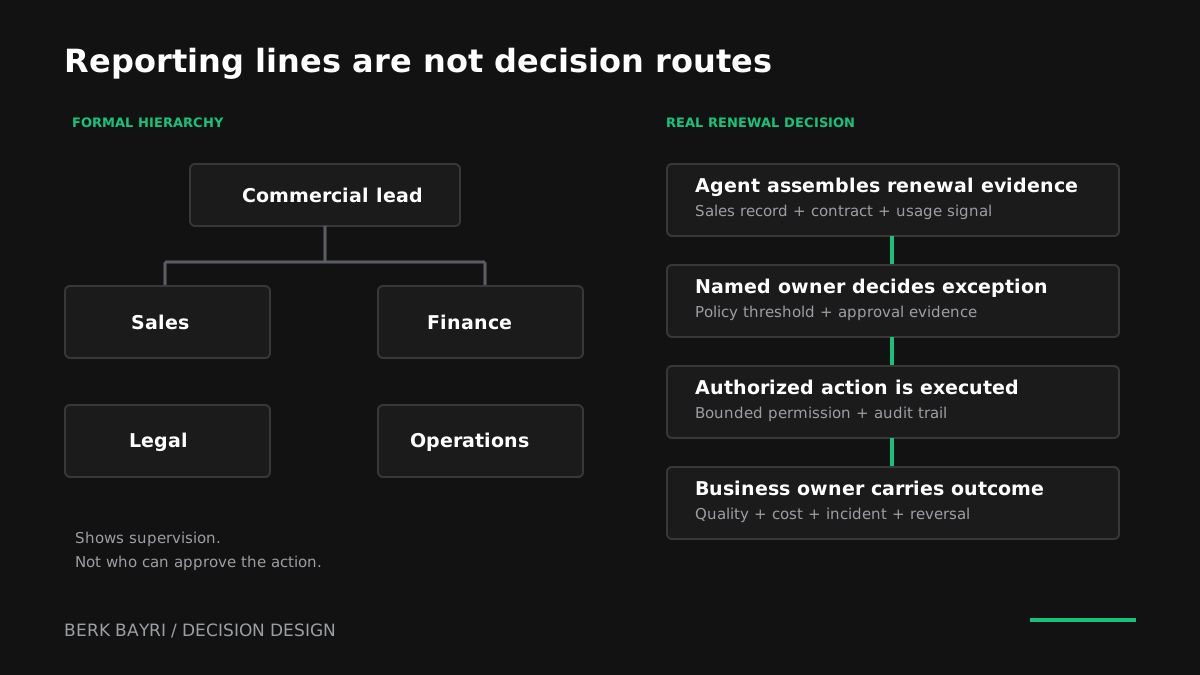
Imagine a customer-success agent preparing a renewal offer. It can read the account history, identify a usage decline, summarize the contract, draft a concession and notify the account manager. The workflow crosses sales, finance, legal and operations before a human has finished a coffee.
Then the agent reaches the question the company has never made explicit: who is allowed to trade margin for retention in this particular case?
The account manager says finance approves discounts. Finance says commercial leadership owns exceptions. Commercial leadership says the account team knows the relationship. Legal wants to know whether the concession changes the contract. The agent has done its assigned tasks, yet the work cannot move. Its most revealing output is not the renewal proposal. It is the organizational ambiguity.
This is why the familiar organization chart is becoming an unreliable description of how a company operates. The boxes describe reporting relationships; the work depends on a different network of permissions, judgments, exceptions and consequences. That network existed long before agents. People kept it functioning through experience, personal relationships and unrecorded negotiations. Agents do not invent the contradiction. They make it harder to hide.
I am not arguing that hierarchy is obsolete, or that every company needs to become a network of autonomous bots. I am arguing for a more practical decision: before scaling agents across functions, map the route by which a real outcome becomes an authorized action. The map will tell you which work to redesign, which human judgment to preserve and which authority the technology must never infer.
The diagram is true. The operating story is not.
An org chart answers useful questions. Who manages this team? Where does a budget sit? Who has formal supervisory responsibility? Employment law, professional development, security and financial control still require those answers. An agent should not be allowed to rewrite them.
But consider a different set of questions. Who can approve an exception to a customer policy? Whose evidence counts when two functions disagree? Who can pause an automated action? Who pays for the extra review work when the model is uncertain? And who has the authority to remove an obsolete handoff rather than merely accelerate it?
Those answers often fail to follow the reporting lines.
A cross-functional process can have four department heads and no single person authorized to change the whole process. A project can have a sponsor and still lack a permanent operating owner. A manager can be accountable for a result while another team controls the system that produces it. None of these arrangements necessarily appears on the org chart. All of them matter when software starts moving work between teams without waiting for the usual informal mediation.
In an earlier essay on coordination and authority, I argued that making handoffs cheaper does not automatically make decisions faster. This essay asks what that remaining delay reveals: an organization may have been using human coordination to compensate for authority it never properly designed.
The October 2026 McKinsey analysis of agentic operating models proposes moving from organization charts toward orchestration charts that show humans, agents and outcomes. That is a useful direction, but a picture of participants is not yet an operating contract. An arrow between an agent and a person does not tell us whether the person has the right to approve, whether the agent has permission to execute, or who absorbs the loss if the decision is wrong.
The missing layer is not another diagram of collaboration. It is a map of decision rights at the point of action.
Follow one decision until someone can say yes
Take the renewal case. A conventional automation inventory would list tasks: retrieve data, draft an offer, check a rule, send a message. A technical architecture would list systems, APIs, permissions and models. Both are necessary. Neither tells the full story of who can legitimately commit the company to a changed commercial promise.
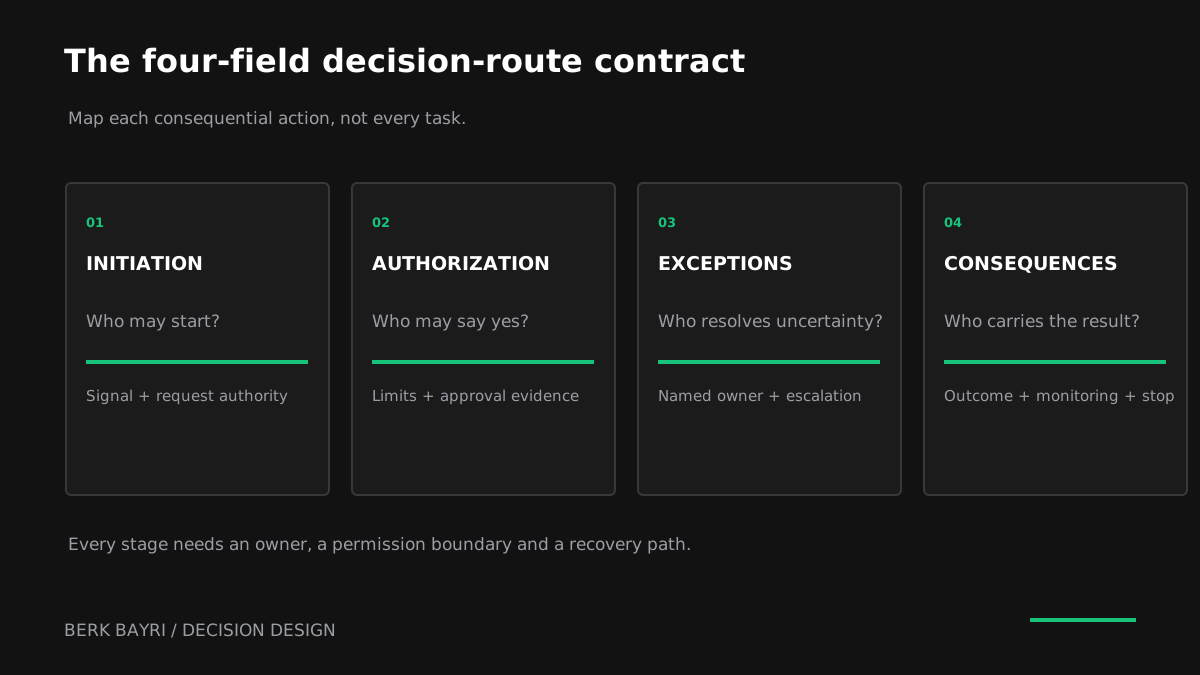
I would start with one consequential decision and document four things.
Initiation. What event starts the work, and who is entitled to request it? A customer signal, a salesperson's request and an agent's own threshold detection are not equivalent forms of authorization. The agent may be permitted to propose a review without being permitted to negotiate a price.
Authorization. Which exact action requires a human decision, under what evidence and limits? A 2% discount within an approved policy might be automatic. A concession involving a new contractual obligation may require named approval. The threshold should be a policy decision, not an assumption embedded in a prompt.
Exception ownership. When the data is contradictory, the customer disputes the recommendation or the policy does not cover the case, who must resolve it? Routing every exception to a generic channel is not ownership. Someone needs both the competence and the authority to make a bounded judgment, or to decline.
Consequence ownership. Who monitors whether the promised outcome happened, investigates harm, funds the operating cost and can suspend the process? An agent can execute a step. It cannot assume the legal, financial and ethical obligations of a company. A successful automated action is not the same as a successful business outcome.
These four fields form a decision-route record. For each important action, record the initiating signal, the permitted action, the approving or exception owner, and the evidence retained afterward. Add a stop condition and a fallback path. Do not make a new bureaucracy of the map: one page for a high-impact workflow is more useful than a hundred pages of generic governance language.
A company with no answer to one of those fields has discovered a design gap, not a model limitation. Buying a more capable agent will not fill it.
Why agents expose what people could conceal
Humans are unusually good at improvising around poorly specified organizations. A trusted employee knows which manager to call, when to seek an unofficial second opinion, how to phrase a request so it gets attention, and when a policy is treated as a guideline rather than a rule. That knowledge can be valuable. It can also make the process fragile, unequal and impossible to audit.
An agent can imitate some of the visible behavior. It can route, retrieve, compare and recommend. But it needs a specification of what counts as a legitimate action. If that specification is missing, the system either stops too often, acts with authority it does not have, or transfers the ambiguity to a human review queue. In all three cases, the underlying problem has become measurable.
The 2026 Microsoft Work Trend Index reports that organizational factors such as management support and culture were more strongly associated with surveyed users' self-reported AI value than individual factors. Its survey of 20,000 AI users and accompanying telemetry provide a substantial view of use patterns, but the reported association is not evidence that one organizational redesign causes a particular financial return. The useful observation is that individual tool proficiency and organizational ability to use it are different variables.
Similarly, Anthropic's September 2025 Economic Index found that enterprise API use in its sampled traffic was heavily automation-oriented and that access to appropriate context appeared to constrain more complex tasks. This describes a provider's own usage, not the entire economy. It suggests a design challenge: agents need more than a prompt and a tool. They need the right organizational context, including which actions are allowed.
A sharper caution comes from METR's randomized study of experienced open-source developers. In the studied early-2025 setting, participants took 19% longer with AI tools. That result cannot be generalized to all agent workflows in 2026. It does demonstrate why the presence of an AI assistant, or a faster intermediate step, should not be mistaken for an observed end-to-end productivity gain.
When agents expose the seams, do not treat every seam as a problem to automate away. Some are the points where the company deliberately exercises judgment.
The difference between a handoff and a decision
A handoff transfers work. A decision commits the organization to a course of action. They may happen in the same interface, but they should not be designed as though they are identical.
Suppose an agent prepares a refund recommendation, checks policy and places the case in a manager's queue. That is a handoff. If the agent issues the refund, it has exercised delegated authority. If it changes the refund threshold for future customers, it has crossed into policy design. Each step requires a different permission boundary and evidence trail.
This is why I favor task-scoped authority over copying a human employee's standing access into an agent identity. The right to read a customer record does not imply the right to change it. The right to recommend an exception does not imply the right to approve it. The right to execute an approved action does not imply the right to rewrite the rule that made it permissible.
The NIST AI Risk Management Framework provides a voluntary structure for governance, mapping, measurement and management. It does not certify an agent or dictate universal approval thresholds. OWASP's October 2026 review of agentic incidents describes cases where reachability, tool access or ambiguous targets became dangerous substitutes for explicit authorization. The examples are incident analyses and reports, not a measured base rate for all deployments. Their lesson is operational: the agent's ability to reach a system must not become the organization's definition of permission.
A good decision route makes this distinction executable. A poor one hides it inside instructions that nobody has agreed to own.
The 30-day decision-route audit
This is not a call for a company-wide reorganization before the first agent can be useful. I would run a small operating experiment on one workflow that already crosses at least two functions and produces a measurable business outcome.
In the first week, select a real decision with enough volume to observe patterns and enough consequence to matter. Write down the accepted outcome, current turnaround time, rework, escalations and the best credible alternative. Do not count model outputs as completed outcomes. Record who actually authorizes exceptions today, including the unofficial workarounds. The aim is to document the existing route without pretending the official process is the entire process.
In the second week, draw the decision route beside the reporting hierarchy. Mark each step as evidence gathering, recommendation, authorization, execution or monitoring. Identify every point where an agent could act and every point where it must stop. Name the permanent business owner and the operational or risk owner. If they disagree, preserve the disagreement: it may be the most important finding.
In the third week, test a bounded redesign. Give the agent only the permissions needed for the selected task. Route exceptions to a named owner with a service expectation, and require a traceable approval before any consequential state change. Include cases with missing evidence, conflicting policy, tool failure and a request outside scope. Measure not only elapsed time but the human rescue work, rejected recommendations and recovery effort.
In the fourth week, compare the result with the baseline. Did an unnecessary handoff disappear, or did the team merely create a faster queue of unresolved approvals? Did the owner gain better information, or inherit more monitoring work? Can a second competent team reproduce the route without relying on the original designer's private knowledge? Those are the questions that justify extending the workflow, narrowing it or stopping it.
| What to observe | A useful signal | A warning sign |
|---|---|---|
| Decision latency | Time from complete evidence to authorized action falls | Drafting is faster but approval backlog grows |
| Exception burden | Exceptions have named owners and predictable resolution | A shared inbox accumulates unowned cases |
| Permission discipline | Actions remain within task-specific limits | Tool access is mistaken for approval |
| Outcome ownership | A permanent owner monitors cost, quality and harm | The pilot team remains the invisible rescue service |
| Transferability | A second team can operate the route | Success depends on informal contacts |
The numbers should be chosen for the workflow, not imported as universal agent benchmarks. An increase in recorded exceptions may even be a positive early result if it exposes failures that were previously invisible. The decision should depend on severity, cost and trend, not on making a dashboard look clean.
The strongest objection is also the most useful
One might reasonably object that companies already have process maps, approval matrices and risk controls. Why introduce another vocabulary? In a mature organization, the answer may be that no new map is needed. If decision rights are current, operational and enforced in the systems agents use, the existing machinery can be sufficient.
The problem is not the absence of documents. It is the distance between the documented route and the one people actually follow. A RACI matrix can name someone accountable without giving that person the ability to change a workflow. A policy can forbid an action while an integration still allows it. A process diagram can show an approval step without identifying who bears the consequence of a mistaken approval. The decision-route audit is valuable only if it closes those gaps in the operating system, not if it produces another presentation.
There is also a danger in overreacting to the technology. Flattening management indiscriminately could remove mentorship, professional standards and necessary separation of duties. Making every decision a centralized approval could destroy the speed agents were meant to create. And replacing entry-level work without redesigning how people learn can weaken the future supply of judgment. The right design will vary by risk, regulation and the kind of work. Some decisions should be automated; some should be delegated with limits; some should remain deliberately human.
The argument is not that agents have made hierarchy fictional. It is that hierarchy was never a sufficient map of work, and the arrival of agents makes that insufficiency expensive to ignore.
What I would ask the executive team to approve
Not a new agent headcount target. Not a flatter org chart. Not a promise that automation will eliminate meetings.
I would ask for one decision: choose a consequential cross-functional workflow and give a named owner the authority to redesign its decision route. Require evidence of the current path, explicit task permissions, human approval where consequences demand it, a workable exception and recovery mechanism, and an end-to-end outcome measure. Give that owner a short review date and the right to stop.
If the experiment works, the organization has learned more than how to deploy an agent. It has learned which parts of its operating model were held together by invisible human labor, which judgments deserve protection, and which permissions need to be redesigned before the next workflow scales.
An org chart may remain exactly where it was on the intranet. That is fine. Its job was never to explain everything.
The more consequential document is the one that can answer, for any action the agent proposes: who allowed this, on what evidence, within which limits, and who will answer for what happens next?
Sources and evidence notes
- McKinsey, “AI is changing work. Now it has to change the organization,” October 5, 2026. Consultancy analysis and reported client examples; useful operating-model framing, not a universal causal estimate.
- Microsoft, 2026 Work Trend Index, May 5, 2026. Vendor telemetry and survey; organizational associations and self-reported outcomes, not randomized financial effects.
- Anthropic, Economic Index, September 15, 2025. First-party platform usage; not representative of all organizations.
- METR, randomized developer productivity study, July 10, 2025. Observed causal result in a narrow early-2025 coding setting; not a general agent-performance forecast.
- NIST, AI Risk Management Framework. Voluntary governance guidance, not a certification or a performance study.
- OWASP, GenAI and Agentic AI Exploit Roundup Q3 2026, October 8, 2026. Case descriptions and security analysis, not prevalence statistics.
- The renewal example, four-field decision-route record and 30-day audit are original analytical proposals by Berk Bayri. Illustrative cases are not represented as observed company results.