Cahit Arf’s 1959 question about thinking machines
In a 1959 text on thinking machines, Cahit Arf moved from clocks and relays to a harder question: what happens when a machine meets a problem that was not anticipated when it was built?
In 1959, Ord. Prof. Dr. Cahit Arf published a deceptively simple question: Can a machine think, and how can it think? The text appeared in Atatürk University’s 1958–1959 Public Lectures series in Erzurum, on pages 91–103 of the 1959 volume. Secondary sources differ on whether the public lecture itself was delivered in 1958 or 1959, so I will refer to the document by what is certain: Arf’s 1959 published text.
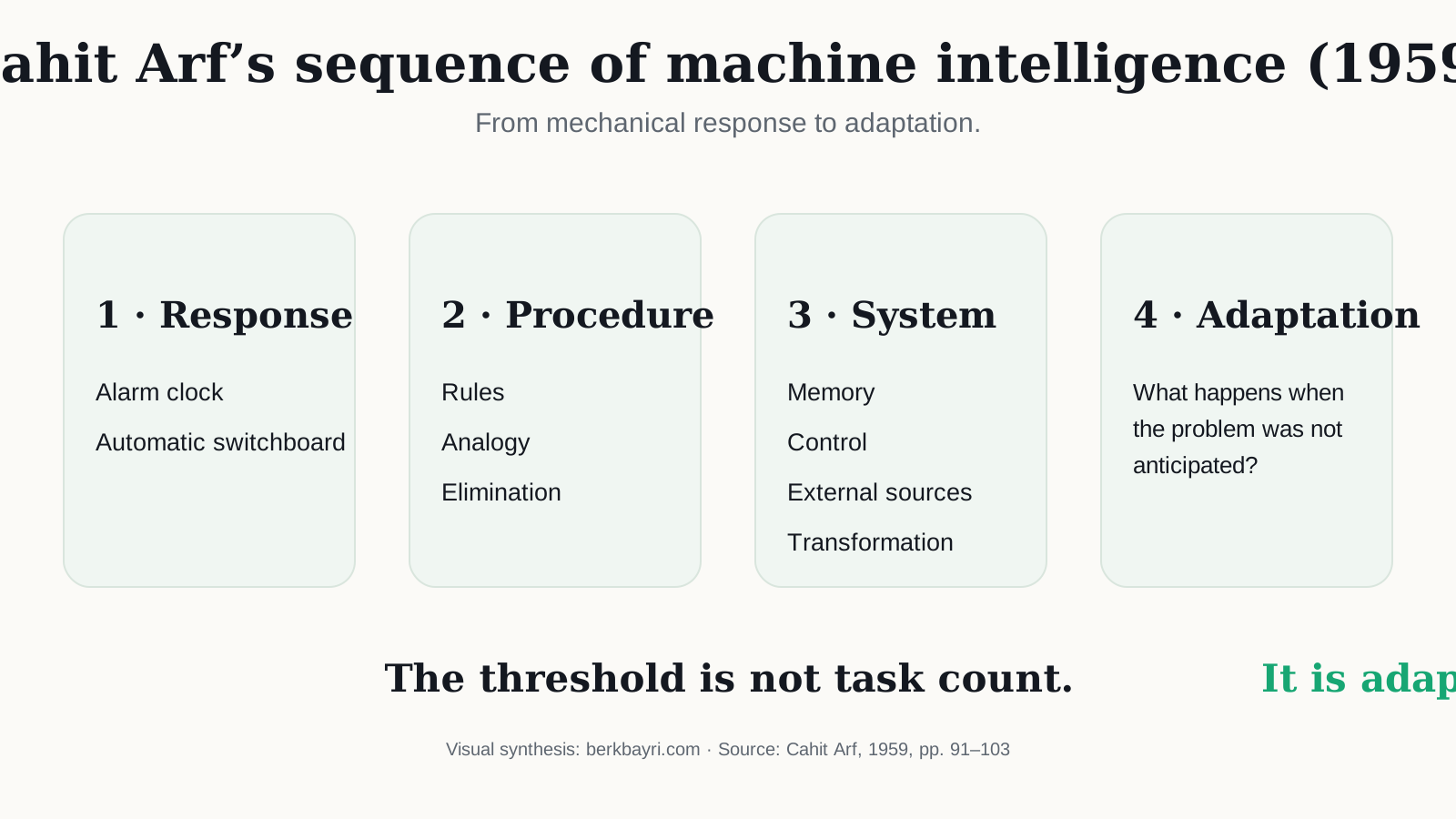
What makes the text worth reading now is not simply its date. Arf moves through a sequence that still feels familiar in AI work: a machine responds to an instruction, then applies procedures, then represents and retrieves information, then uses internal and external memory, and finally reaches the harder question of what happens when the problem was not already anticipated in the machine’s design. The technology has changed radically; the progression from programmed competence to adaptive behaviour remains recognisable.
The mathematician behind the question
Arf was not primarily a computer scientist. Cahit Arf (1910–1997) was one of Turkey’s most internationally significant mathematicians: educated at the École Normale Supérieure in Paris, a doctoral student of Helmut Hasse at Göttingen, professor at Istanbul University from 1943 and ordinaryüs profesör — Ordinary Professor — from 1955. His name remains part of mathematics through the Hasse–Arf theorem, Arf invariant, Arf rings and related work; he later played an important role in TÜBİTAK and chaired its Science Board. A concise biography is available on Wikipedia, while the Turkish Mathematical Society provides a more institutional account.
That background matters because the lecture reads like an exercise in structural thinking. Arf does not begin by asking whether a machine resembles a person. He asks what operations we are calling “thinking,” how those operations can be decomposed, and at what point a pre-arranged procedure stops being a satisfactory explanation. In the wider history of the field, this sits after Turing’s 1950 Computing Machinery and Intelligence and the 1955 Dartmouth proposal that named “artificial intelligence”; Arf’s contribution here is the particular path he takes through the problem.
Understanding before machinery
The opening pages are not about computers at all. Arf talks about akl-ı selim — sound judgment or common sense — and argues that expertise should help us exercise our own understanding rather than become a conclusion we repeat because an authority said it. When something looks complicated, his method is to break the unfamiliar phenomenon into simpler mechanisms, understand those mechanisms, then build upward patiently.
He applies the same method to the “electronic brains” of his time. Rather than treating them as mysterious objects, he reduces their behaviour to representations, switches, relays, memory and logical transformations. This remains a useful discipline in today’s AI vocabulary: “foundation model,” “reasoning model,” “agent” and “multimodal AI” name categories, but they do not by themselves explain what a system receives, what it stores, what it can retrieve, how it transforms information, what it is allowed to do, or where it fails.
From response to procedure
Arf deliberately begins with a weak example of machine “thinking”: an alarm clock. An instruction is encoded by setting the clock; at the specified time it produces a response. He then moves to an automatic telephone exchange and to more elaborate mechanical constructions, including a device that solves the familiar heads-and-legs problem with chickens and rabbits and another that applies inheritance rules by eliminating outcomes inconsistent with the stated conditions.
The point of the sequence is not to argue that a clock possesses a mind. It is to separate increasingly complex forms of behaviour. A machine can react to an input, apply a rule, transform a representation and select among alternatives, yet those capabilities still leave open the harder question of flexibility. Arf discusses reasoning through analogy and elimination and connects them to analog and digital machines, but he keeps moving the threshold beyond the successful execution of a known procedure.
The threshold is adaptation
The strongest turn comes when Arf asks what would happen if a machine could solve not one problem but ten thousand. His answer is that the number is not decisive if all ten thousand were, in effect, already solved when the machine was designed. He instead foregrounds intibak kabiliyeti — the ability to adapt — and asks whether a machine could solve problems that had not been considered when it was built.
That distinction maps directly onto a modern evaluation problem. A model can perform well across hundreds of benchmarks and still be brittle outside the tested distribution; an agent can complete an impressive happy-path workflow and fail when a tool returns an unexpected state; a system can look capable until evidence is incomplete, instructions conflict or success requires a combination of abilities that was never tested together. In current language we might discuss generalisation, robustness, out-of-distribution performance and recovery, but the underlying separation is similar: task coverage is not the same thing as behaviour under novelty.
Intelligence as a system of interacting functions
To think about adaptation, Arf sketches a simplified model of the brain. A question or observation first enters ön hafıza, preliminary memory. A control centre then retrieves relevant material from a larger memory store; some of that material may effectively instruct the system to ask another person or consult a book, which Arf treats as yardımcı hafıza, auxiliary memory outside the brain. The gathered material is transformed through logic or analogy, the result is expressed, and it is also written back into memory.
The resemblance to parts of a modern AI stack is useful as long as it stays a comparison rather than an equivalence. Preliminary memory is not a transformer context window, auxiliary memory is not RAG, the control centre is not an agent framework, and the transformation mechanism is not an LLM. The deeper connection is architectural: intelligence is being modelled as the interaction of context, stored knowledge, control, external resources, transformation, output and memory update rather than as the property of one magical component.
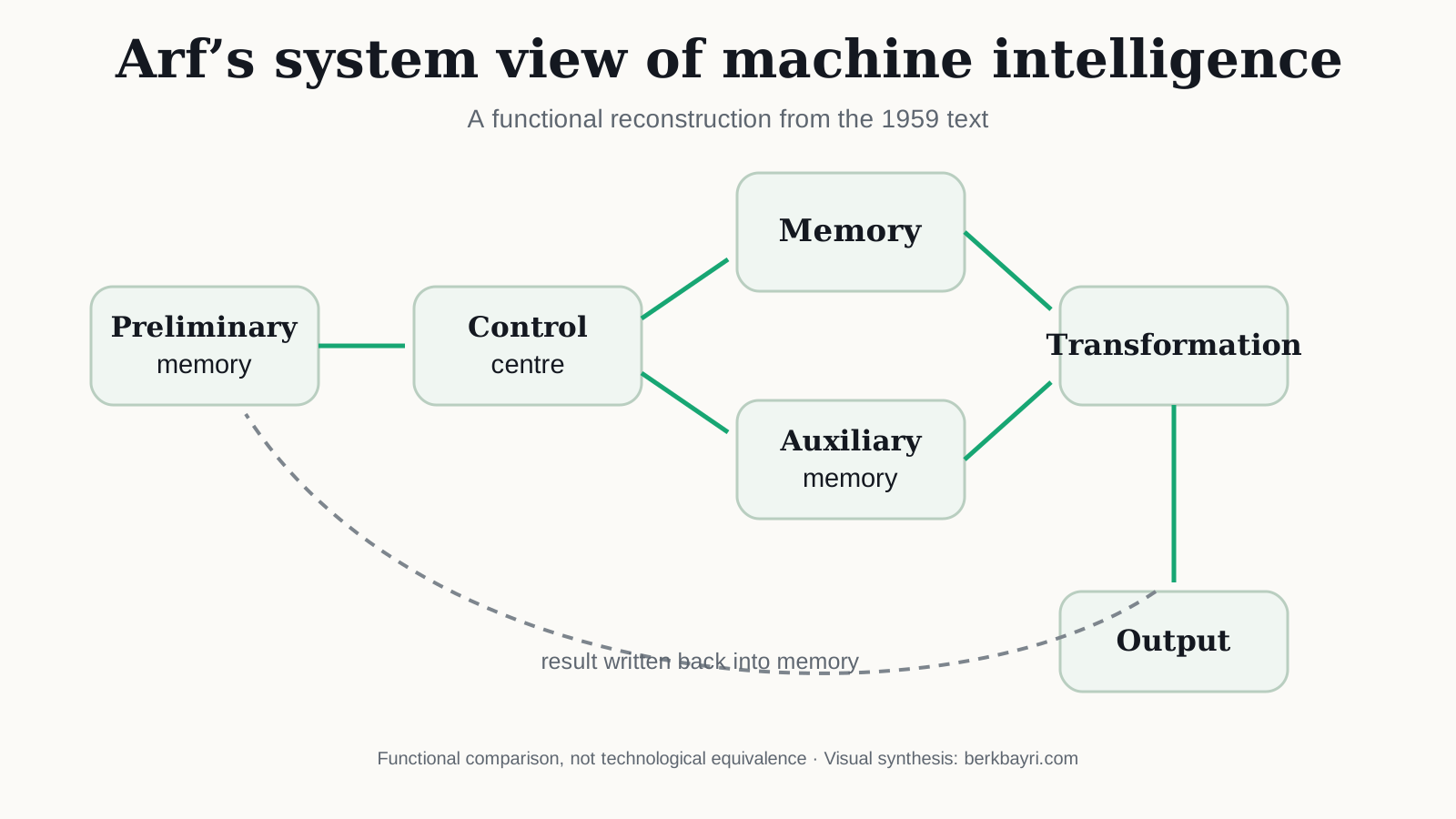
That systems view has become more relevant as AI products have grown beyond a single model call. A production system may now include a model, retrieved context, tools, permissions, persistent state, routing, interfaces, human review, monitoring and recovery. When such a system succeeds or fails, the explanation rarely lives in the model alone; the behaviour emerges from the configuration.
Language becomes representation
Arf next turns to the machine’s input and output language. He explains that expressive richness does not require a large primitive alphabet: sequences of only two symbols, 0 and 1, can represent many distinctions if the system can store and transform them according to rules. From there he moves into switches, relays, memory elements and elementary logical operations.
The hardware is historical, but the intellectual move still matters. Words such as thinking and understanding are not allowed to do explanatory work on their own. If a system is said to receive information, we should ask how the information is represented; if it remembers, what state persists; if it selects what matters, what process performs the selection; and if it transforms information, what mechanism produces the change. Modern neural systems answer these questions very differently from relay logic, but the demand for a mechanism remains.
What modern AI changes
There is also a major difference between Arf’s examples and contemporary machine learning. The machines in his lecture are largely understandable through explicitly designed procedures and symbolic or electromechanical mechanisms; modern foundation models learn distributed statistical representations from vast datasets and can produce behaviour that was not individually programmed task by task. Their capabilities emerge from training, architecture, data and inference dynamics in ways that are far less transparent than a relay circuit.
At the same time, the systems built around those models increasingly recover some of the functional categories Arf was interested in. We add working context, retrieval, external tools, memory, routing and feedback because a model alone is often not enough to perform reliable work in a changing environment. The similarity is therefore not that a 1959 diagram secretly contained the modern stack; it is that both views force us to distinguish the component that transforms information from the larger system that makes useful behaviour possible.
Learning changes the category of machine
Near the end of the lecture, Arf compares the machines of his time with the human brain. Machines can perform certain operations much faster, he says, but the range of influences they can receive is much narrower; a human can improve through initiative, while an ordinary machine remains as it was built. He then adds that a self-improving machine can in principle be designed.
Today that idea fragments into several different mechanisms. Model weights can be updated through training or fine-tuning, external memory can accumulate, an agent can revise a plan after observing a result, and a workflow can change routing or tool choice without the underlying model learning anything at all. This makes Arf’s distinction more, not less, useful: once a system can change, we have to ask what changes, in response to which signal, within whose limits, and with what effect on future behaviour. That is a technical question and a governance question at the same time.
Where computation meets judgment
Arf’s final comparison becomes more philosophical. He focuses on aesthetic influence, aesthetic judgment and the felt freedom to decide whether to perform an action, and notes that these phenomena appear to contain uncertainty rather than fully explicit, exceptionless rules. He speculates about whether indeterminate physical events might contribute to something analogous in a machine, while also acknowledging that such a machine might remain out of reach.
The modern parallel is not that randomness creates creativity. Generative systems already use stochastic processes and can produce different outputs from the same prompt, imitate styles and optimise against preference signals, yet variation is not identical to taste, intention or authorship. A model can rank two designs and an agent can choose between two actions, but describing those behaviours as judgment, agency or aesthetic experience adds a philosophical claim to the technical observation.
A question that survived the machinery
Read as a whole, Arf’s lecture is held together by a consistent method: do not stop at labels. “Electronic brain” is not an explanation, and neither are today’s labels “AI,” “reasoning model” or “agent.” The useful questions ask what information the system can receive, how it represents and retrieves that information, what it can use from outside itself, what can change over time, and what happens when the situation was not anticipated.
The machines of 1959 and the AI systems of 2026 are separated by enormous technical differences. What survives is the need to distinguish known procedures from adaptive behaviour, a component from a system, variability from judgment, and an impressive catalogue of capabilities from performance under novelty. Arf’s question is still useful because the answer keeps changing while the structure of the inquiry remains productive.
Sources
Get new essays as they publish.
One email per essay. No noise between.
Berk Bayri
Creative Technology & Innovation Leader
Designing and building for digital environments since 1998, across strategy, product, design, technology and organizational innovation.