The most valuable AI project may be a policy change, not a product
Before you fund an AI system to handle a slow process, find the rule that created the work. Changing the rule can beat automating it.
Most AI proposals begin with a pain. Invoices take too long to approve. Contract reviews pile up. Customers wait for a second signature on a refund. The proposal then describes a system that will handle the work faster.
Far less often does anyone ask who wrote the rule that created the work.
Take an illustrative example, not a case study. A finance team reviews every expense claim above 50 euros by hand. The review catches few errors, but it has always been done, and the queue is long. Someone proposes a model that reads receipts and flags anomalies. The project gets a budget, a vendor shortlist and a pilot date.
Meanwhile nobody has priced a different option: raise the threshold to 200 euros, sample the claims below it, and keep full review for everything above. That option is a policy change. It needs no model, no integration and no procurement. It does need someone with the authority to accept a different risk from the one the organization has been avoiding by default.
Where work comes from
Some work exists because the business needs it. A great deal exists because a rule says so, and the rule is often older than the people following it. Four kinds are worth looking for first:
- A threshold that sends too many cases to a person, like the 50-euro line above.
- A mandatory field or form that was added for one downstream reader who no longer reads it.
- A sequential approval where the second approver sees only what the first one already approved.
- An exception path that has quietly become the ordinary path.
Each of these generates volume. An AI system can process that volume. A rule change can shrink it. The two options differ in what they leave behind. A system built to process unnecessary work leaves the work in place, now with a model to maintain, monitor and explain.
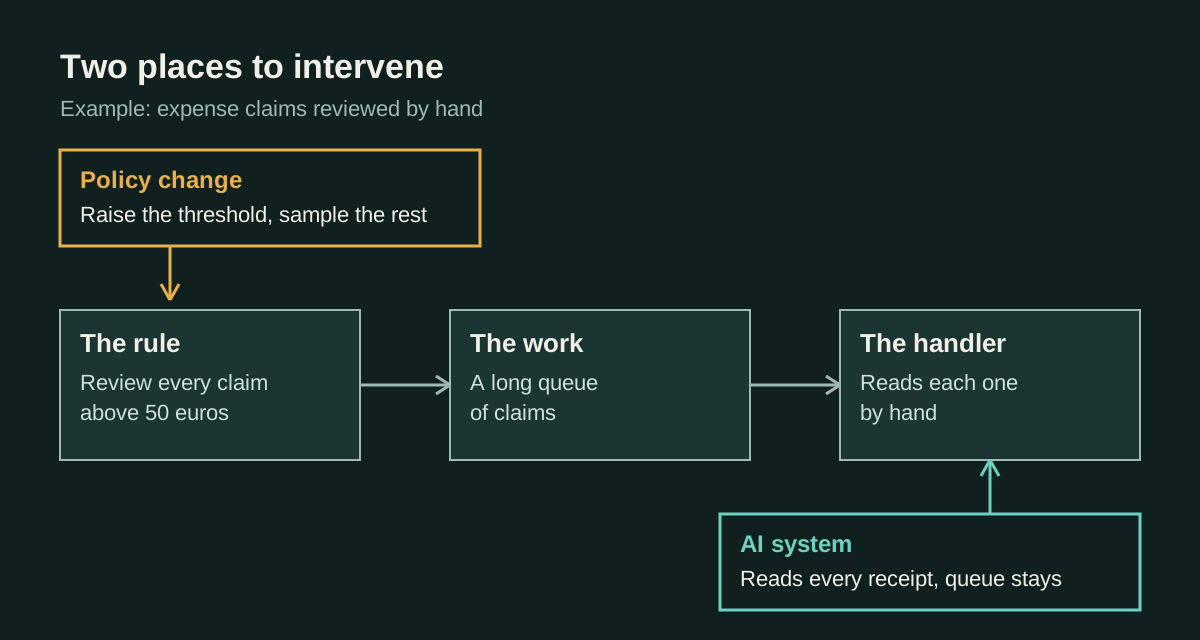
The counterfactual nobody prices
My argument is a small procedure, not a verdict. Before approving an AI build for a process, I would ask for four things on one page.
- The rule behind the work. Which rule, policy or habit creates this volume? When was it written, for what risk, and who owns it today?
- The risk it controls. What goes wrong if the rule is loosened, narrowed or replaced by sampling? If no one can answer, that is a finding in itself.
- The change and its owner. What would the new rule say, and who has the authority to adopt it, or to refuse it in writing?
- A side-by-side with the AI proposal. Same measures for both: cost to implement, time until the effect shows, error exposure and how easily it can be reversed.
The last measure deserves attention. A rule change can often be undone by the person who made it. A deployed system that other workflows now depend on takes longer to unwind. That is a tendency, not a law, but it should appear in the comparison.
Why the product usually wins the meeting
A product purchase fits the budget process the organization already has. A rule change asks someone to own a risk personally. The rule usually belongs to risk, compliance, finance or legal. The team that suffers its volume sits elsewhere. The AI team sits somewhere else again.
So the proposal travels to where the budget is, not to where the cause is. This is an inference from how approval structures tend to work, not a measured finding. It does explain why a rule that costs hundreds of hours a month can survive for years while a model to handle those hours gets funded in a quarter.
What the evidence does and does not say
McKinsey's 2026 State of AI survey, published on 25 August 2026, was fielded from 4 May to 8 June 2026 and drew 1,719 respondents in 97 countries. It reports that nearly three-quarters of the respondents it classifies as high performers say they fundamentally redesigned workflows because of AI, against about a quarter of everyone else (McKinsey, The state of AI in 2026, read on 19 November 2026).
Read that with care. The figures are self-reported, the high-performer group is small, the findings are correlational and McKinsey sells AI services. The survey does not test rule changes at all. What it supports is narrower: organizations that report stronger results are more likely to say they changed how the work is organized, not only which tool performs it.
When the rule should stay
Some rules control real risk: fraud, safety, a legal duty. Dropping them to avoid a project is not strategy. The check is old and simple. If nobody can say what a rule protects, that is worth finding out. If someone can, test whether the control still does its job at its current cost.
And sometimes the AI system is the right answer. The rule may be sound, the volume real and the judgment hard to specify. AI can also make a stricter rule affordable. In the expense example, a model that reads every receipt could replace sampling with full coverage, a better policy that only became practical because of the product.
So the two are not rivals. The sequence matters. Decide the rule first, then size the system for the work that remains.
A question for the intake form
Most AI intake forms ask what the system will do, who will use it and what data it needs. I would add one line: which rule created this work, and what would it cost to change it?
If the answer is that no one knows who owns the rule, the first project is finding out.