Your AI program can be efficient and still be strategically irrelevant
AI can make low-value work dramatically cheaper. That is still low-value work. The portfolio question is not only what became faster, but whether the work deserved investment in the first place.
AI can make a process faster, cheaper and easier to measure without making that process more important to the business. Efficiency answers whether work improved. Strategy asks whether the work deserved investment in the first place.
Imagine an AI program with excellent internal metrics.
People are saving time. Response times are down. More documents are processed per employee. Model costs are falling. The number of automated tasks is rising. Adoption is healthy. Teams can show before-and-after charts that make the technology look unquestionably useful.
Now ask a different question:
If every one of those improvements disappeared tomorrow, which important business outcome would materially get worse?
That question is harder.
A company can become very good at using AI on work that is only weakly connected to its strategy.
That is the uncomfortable distinction many AI programs still avoid.
Efficiency tells you whether the work became cheaper. Strategic relevance tells you whether the work deserved the investment.
Efficiency is always local
Efficiency is a ratio inside a chosen activity.
A proposal takes two hours instead of four. A support agent handles more cases. An analyst produces the report faster. A recruiter screens more applications. A marketing team generates more variations. A developer closes more tickets.
Those can all be legitimate improvements.
But the metric begins after someone has already decided that the activity matters.
That is why efficiency can mislead at portfolio level.
An AI initiative may be locally excellent and globally unimportant.
The organization can optimize the wrong work.
This is not theoretical. McKinsey's 2026 State of AI research found a striking gap between individual productivity and enterprise economics: 80 percent of respondents said AI had improved their individual productivity, while 37 percent attributed any EBIT impact to AI and only 6 percent qualified as high performers. High performers were far more likely to substantially redesign workflows rather than simply improve isolated activities.
BCG reports the same structural pattern from a different dataset. In its 2026 AI Radar work, 82 percent of CEOs said they were more optimistic about AI ROI than a year earlier, while only 6 percent of companies were seeing what BCG classified as meaningful value in reduced costs and increased revenue. Its strongest performers were not doing more AI everywhere. They were concentrating investment in fewer, higher-impact areas and redesigning end-to-end processes.
The common signal is not that AI productivity is fake.
It is that productivity does not choose its own strategic destination.
The dangerous quadrant is "efficient but irrelevant"
I would separate every AI initiative along two axes:
- Operational efficiency: does AI materially improve the cost, speed, quality or reliability of the work?
- Strategic relevance: does improving this work materially affect a business priority, binding constraint, differentiated capability, customer outcome, risk exposure or P&L line that leadership actually cares about?
That produces four very different decisions.
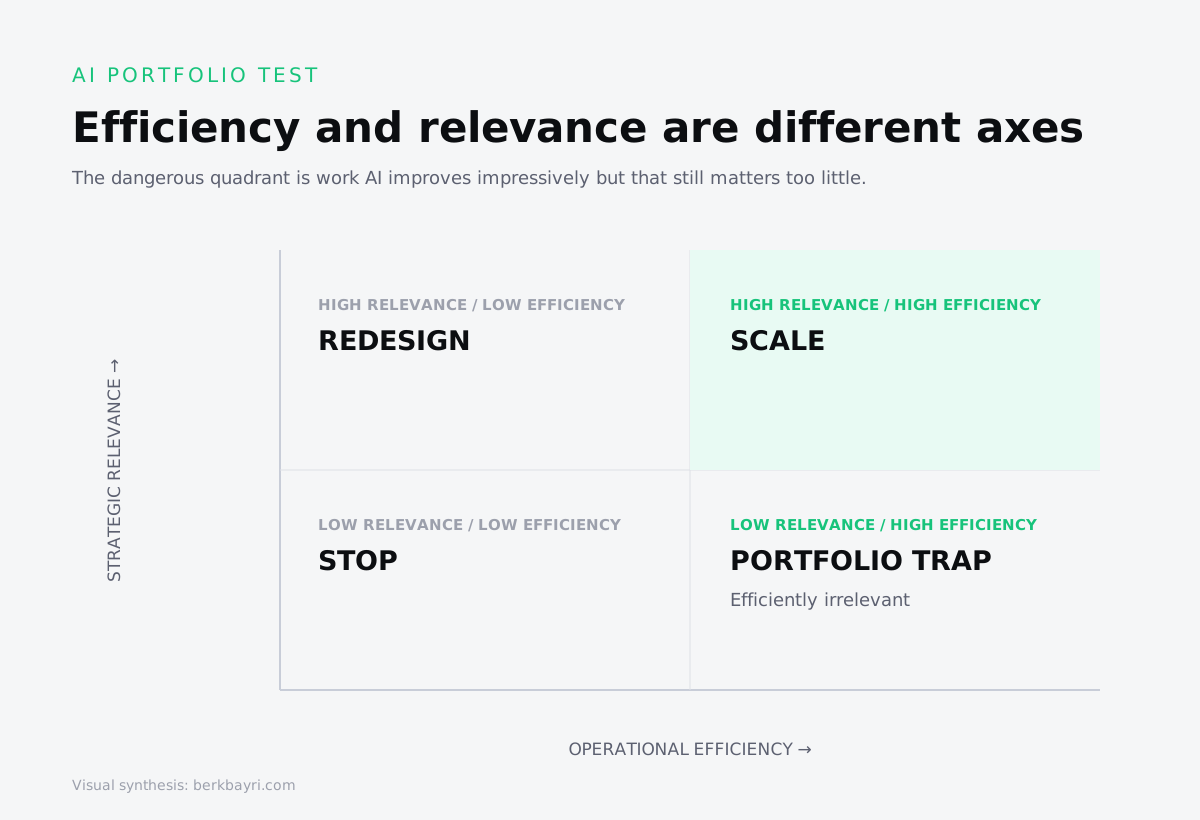
High relevance, high efficiency: scale carefully. The initiative is improving work that matters.
High relevance, low efficiency: redesign before abandoning it. The problem may be strategically important even if the current AI implementation is weak.
Low relevance, low efficiency: stop. There is little reason to defend the initiative.
Low relevance, high efficiency: this is the interesting one.
It produces great demos.
It creates enthusiastic users.
It generates clean metrics.
It can still be the wrong place for the next dollar.
That is the efficiently irrelevant quadrant.
AI makes the wrong work cheaper too
One reason this trap is becoming more common is that AI reduces the cost of many activities that companies never previously questioned.
A report nobody acts on becomes easier to generate.
A meeting nobody should need becomes easier to summarize.
A document nobody wants to read becomes easier to draft.
An approval pack for an unnecessary approval becomes easier to prepare.
A team can now produce five versions of a deliverable instead of two, even if the additional three create no decision value.
This is a different problem from the one I argued in Stop Adopting AI.
That essay asked whether companies were installing new intelligence inside old operating models.
This one asks a prior portfolio question:
Even if the AI works perfectly, are we improving work that should still command scarce company resources?
The answer can be no.
AI can make a low-value activity extremely efficient without making it strategically relevant.
The field evidence already hints at the distinction
A large randomized field experiment across 66 firms and 7,137 knowledge workers is useful here because it separates individual-level improvement from organizational change.
Workers who received access to generative AI spent less time on email and worked less outside normal hours. Those are meaningful benefits. But the researchers did not detect significant shifts in the quantity or composition of workers' tasks from individual-level AI provision alone.
The lesson is not that saving time is worthless.
The lesson is that making existing work easier does not automatically change what work gets done.
That second decision belongs to the organization.
BCG makes the economic version of the same point: efficiency gains are often reabsorbed into the system unless leadership deliberately redirects the released capacity into lower cost, higher throughput, revenue growth, better service or another measurable outcome.
A 20 percent faster activity does not create 20 percent business value by itself.
Something downstream has to change.
And before that, someone has to decide whether the activity belongs in the strategic portfolio at all.
Strategy is partly the decision not to optimize something
AI programs are naturally biased toward solvable opportunities.
Teams search for tasks with enough volume, enough data and enough repetition to automate.
That is reasonable for delivery.
It is not sufficient for strategy.
The most automatable workflow is not necessarily the most important workflow.
The easiest efficiency win may sit far away from the business's actual constraint.
OpenAI's own 2026 opportunity-sequencing worksheet starts with a business priority and leadership decision before comparing AI opportunities. It asks whether changing a workflow addresses a real business constraint and whether the intended outcome is consequential enough for leadership to evaluate.
That ordering matters.
Business priority → important work → AI opportunity is a different pipeline from AI capability → possible use case → adoption.
The first is strategic selection.
The second can become solution shopping.
Start before the use case
Before asking whether AI can improve a workflow, ask whether improving that workflow would still deserve investment if AI did not exist. If the answer is weak, technical feasibility should not rescue the business case.
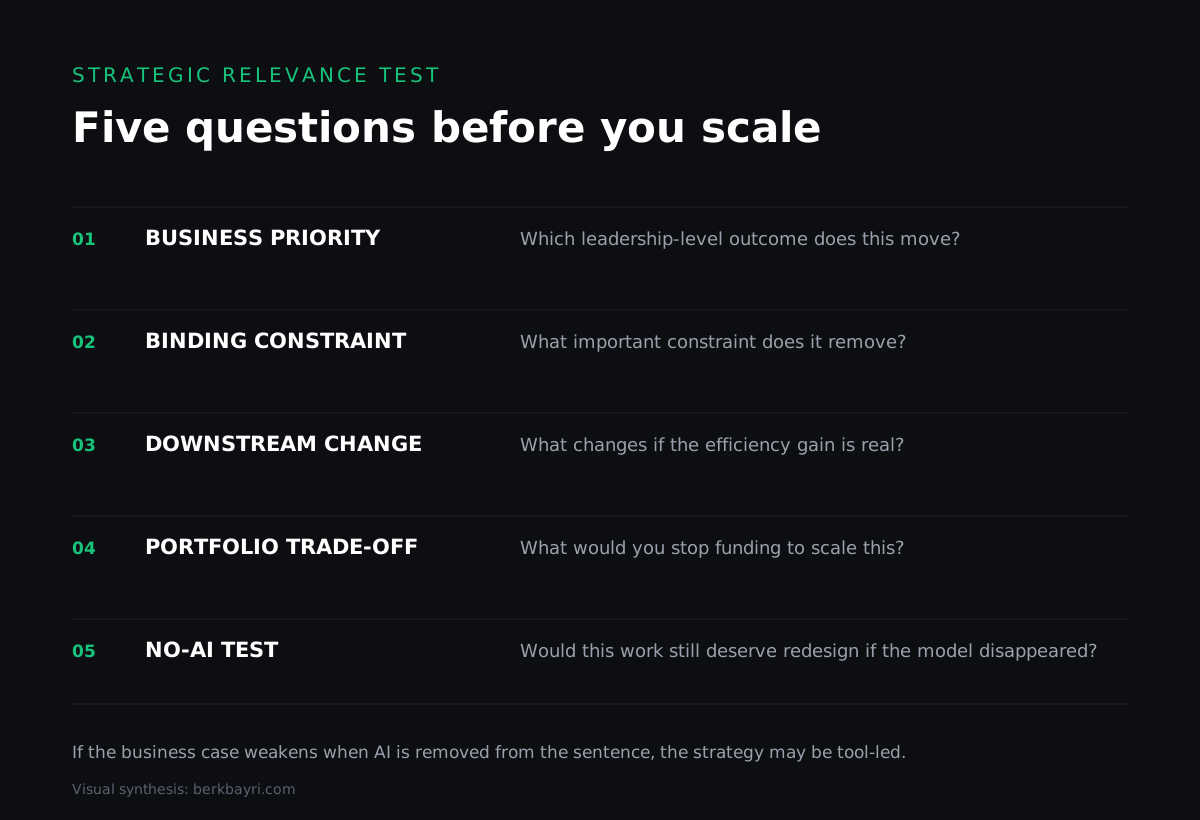
I would use a five-question strategic relevance test
Before scaling an AI initiative, I would ask five questions.
1. Which business priority does this move?
Not which department uses it.
Not which KPI the product team can instrument.
Which priority would leadership recognize without mentioning AI?
Margin. Growth. Customer retention. Risk. Working capital. Product velocity. Service quality. A strategic capability the business is intentionally building.
If the initiative requires a long explanation of why the metric matters, the link may be too weak.
2. Which constraint does it remove?
A strategically relevant initiative usually changes a constraint.
Capacity.
Decision latency.
Expertise.
Coordination.
Quality variation.
Customer friction.
A regulatory exposure.
A scarce capability.
If the work becomes faster but the system's binding constraint remains exactly where it was, the gain may stay local.
3. What changes downstream if the efficiency is real?
Suppose the claimed productivity gain is true.
Then what?
Do fewer external providers need to be purchased?
Does throughput rise?
Does the customer receive a faster resolution?
Can the organization handle more demand without adding capacity?
Does revenue appear sooner?
Does risk fall?
If nothing downstream changes, the program may be producing theoretical capacity rather than business value.
4. What would we stop funding to scale this?
This question converts AI enthusiasm into portfolio discipline.
Every meaningful scale decision consumes budget, integration capacity, governance capacity, leadership attention and change capacity.
If leaders would not take resources away from another initiative to fund this one, they may not believe it is as strategically important as the slide deck suggests.
5. Would we redesign the work even if the model disappeared?
This is my favorite test.
If the AI vanished tomorrow, did the initiative reveal something structurally wrong or strategically important enough that the company would still want to redesign the workflow?
If yes, AI may be exposing a real business problem.
If no, the initiative may be mostly about the tool.
Positive ROI can still be strategically weak
This is where the argument becomes more uncomfortable.
An initiative can have positive ROI and still be the wrong investment.
Suppose an AI system costs €100,000 a year and creates €180,000 of measurable savings.
That is a good local business case.
But imagine the same organization has another initiative that uses the same implementation team, data platform and change capacity and could unlock €2 million of value.
The first initiative did not suddenly become bad.
It became strategically weaker by comparison.
This is why your AI agent estate becomes a capital allocation problem as it grows.
Portfolio value is relative.
Positive ROI is an entry condition, not an automatic claim on the next unit of capacity.
BCG's July 2026 CEO survey makes this prioritization gap visible. Nearly nine in ten CEOs reported some cost or revenue benefit from AI in targeted areas, while most were still struggling to scale enterprise financial impact. More than half identified the link between AI initiatives and P&L as a barrier, but only 14 percent had clearly defined P&L impact for all AI initiatives.
That is what a portfolio looks like when local wins outrun strategic allocation.
The executive dashboard should separate activity, efficiency and relevance
I would not put AI metrics into one undifferentiated scorecard.
They answer different questions.
Activity: Are people using it?
Licenses, active users, prompts, workflows, agent runs.
Efficiency: Is the work getting cheaper, faster or better?
Time saved, cost per accepted outcome, cycle time, error rate, supervision load.
Strategic relevance: Is this work important enough to deserve more investment?
P&L effect, constraint removed, customer outcome, risk reduced, capability strengthened, differentiated advantage, capital trade-off.
The first category tells you whether AI is present.
The second tells you whether it works.
The third tells you whether it matters.
A mature program needs all three.
But they should never be confused.
An efficient AI program can optimize itself away from strategy
There is a final irony.
The better the AI team becomes at delivery, the easier it becomes to produce impressive improvements across the company.
That can make prioritization harder, not easier.
When almost every function can show a plausible use case and a positive efficiency story, technical feasibility stops being a useful filter.
Leadership has to become more selective.
That is why the next stage of AI strategy is not finding more opportunities.
It is rejecting good opportunities in order to fund more important ones.
A strong AI program should be able to say:
Yes, this works.
Yes, users like it.
Yes, it saves time.
And no, we are not scaling it.
Because strategy is not the accumulation of locally rational improvements.
It is the discipline of deciding which improvements matter enough to change the company.