Stop asking what AI can do. Ask what your company can absorb.
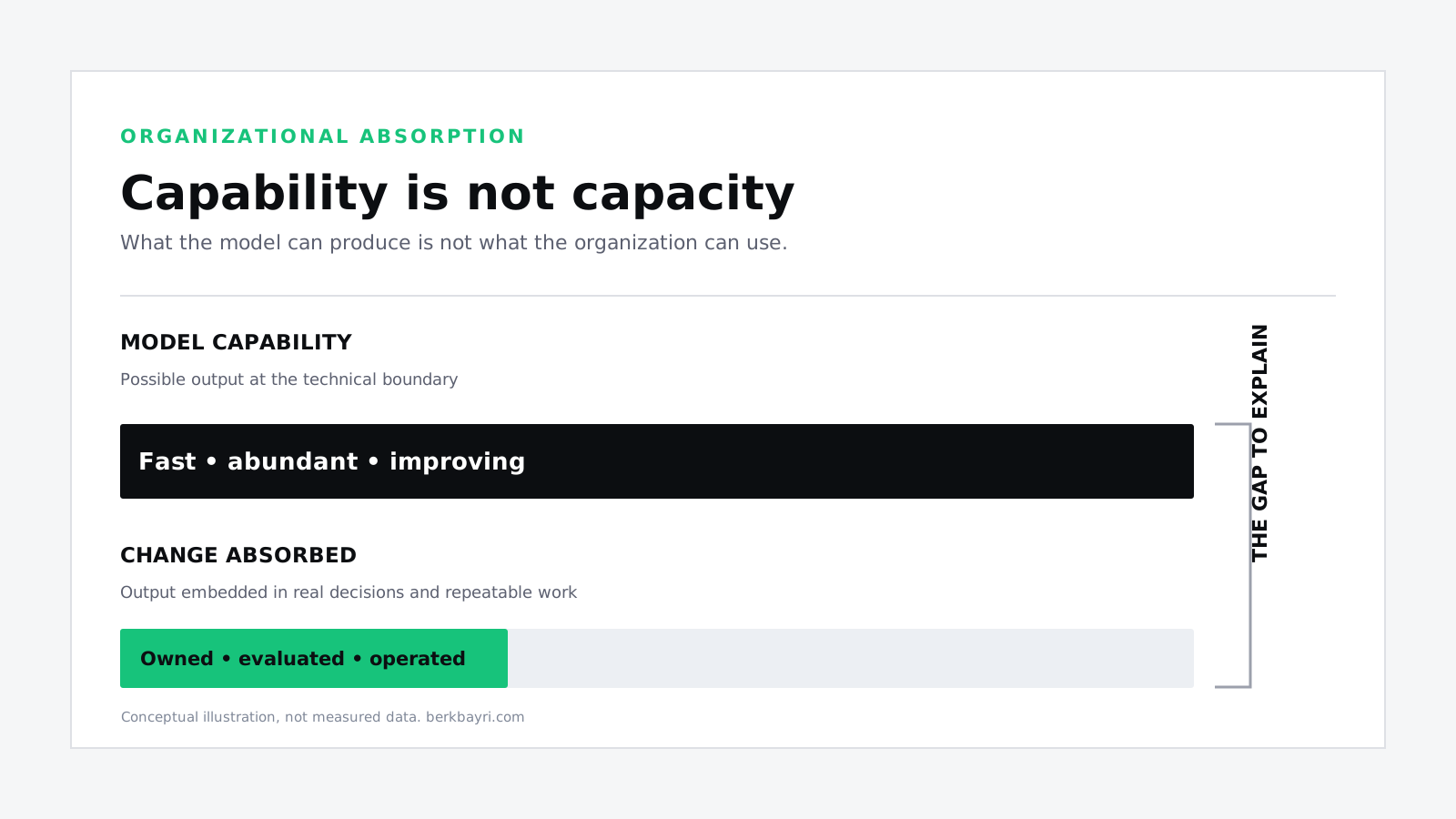
The gap that matters is between what AI can produce and the changes an organization can reliably absorb into ordinary work.
The useful constraint on an AI strategy may no longer be what the technology can produce. It may be how much change the organization can turn into ordinary, accountable work.
In a field experiment involving 7,137 knowledge workers across 66 firms, people who used an AI assistant spent about two fewer hours per week on email in the later half of the study. They also spent less time working outside regular hours. Yet the researchers did not detect a corresponding change in the quantity or composition of tasks from providing AI to individuals.1 This does not make the time savings imaginary. It makes their organizational destination uncertain.
Imagine being able to demonstrate those gains in a leadership meeting. The model works. The employees use it. The evidence is promising. You approve a larger rollout. Six months later, everyone has a faster way of producing drafts, replies and summaries, while the approvals, reporting cycles and decisions around that work look familiar.
That is not a hypothetical failure of model intelligence. It is a plausible failure of organizational absorption.
The question I would ask before funding the next wave is no longer just What else can this model do? It is What can this company actually change without relying indefinitely on a handful of unusually committed people to hold the change together?
The model finishes. The organization is still deciding.
AI can draft an answer, classify a case or propose an action in seconds. The organization may need days to decide whether the answer is acceptable, where it belongs in the process, who has permission to act on it and who will be accountable if it is wrong. Speed on one side of that boundary does not remove work on the other.
Consider an illustrative insurance-claims process. An AI system prepares a well-supported recommendation. That recommendation must still be checked against policy, translated into a decision the claims team is authorized to make, entered into a system of record, explained to a customer when disputed and monitored for patterns of error. Perhaps the right decision is to keep human approval for certain claims. That is sensible. But without a deliberate operating design, the company has only added a fast producer to a slow process. The queue has moved, not disappeared.
A large customer-support study, later published in the Quarterly Journal of Economics, found an average 14% improvement in issues resolved per hour when agents had access to an AI assistant. The gains were much larger for less-experienced workers, consistent with the tool helping transmit effective practices.2 This is evidence that AI can matter in real operational work. It is not evidence that every process can take on a similar improvement without redesign.
Both findings can be true: the tool genuinely helps, and the organization has not yet made room for the help.
We have spent decades studying the other half of innovation
In 1990, Wesley Cohen and Daniel Levinthal described absorptive capacity as an organization's ability to recognize the value of external knowledge, assimilate it and apply it.3 Their argument was about innovation more broadly, not today's AI systems. But it gives the present debate a useful historical counterweight: access to knowledge has never guaranteed an institution can put it to work.
AI makes the distinction unusually visible because the supply of plausible output can expand quickly. The capacity to examine it, make decisions with it, change habits around it and maintain quality tends to be built more slowly. An organization can buy more inference capacity this month. It cannot necessarily buy the judgment, trust, data stewardship and authority structure needed to absorb the extra volume on the same schedule.
The OECD's 2025 study of AI adoption in firms identifies skills and data maturity as important barriers, while also describing the often underestimated changes to business practices and culture that implementation demands.4 Those findings draw on specific enterprise samples and diffusion institutions; they are not a universal readiness score. They reinforce a practical point: the bottleneck is frequently outside the model.
This is why I am wary of AI strategies expressed chiefly as a list of tools to deploy or employees to train. Training matters, but it cannot confer decision rights on someone whose role does not include them. It cannot create a trusted source of data that is missing. And it cannot make a manager stop asking for an old report simply because its underlying work is now automated.
The invisible queue between an output and a changed company
I would treat organizational absorption as a queue with four distinct boundaries.
The system produces an output. Someone or something accepts it against a quality and risk standard. A team integrates the accepted output into a changed decision or workflow. Then the organization operates that new way of working, including exceptions, escalation, monitoring and learning.
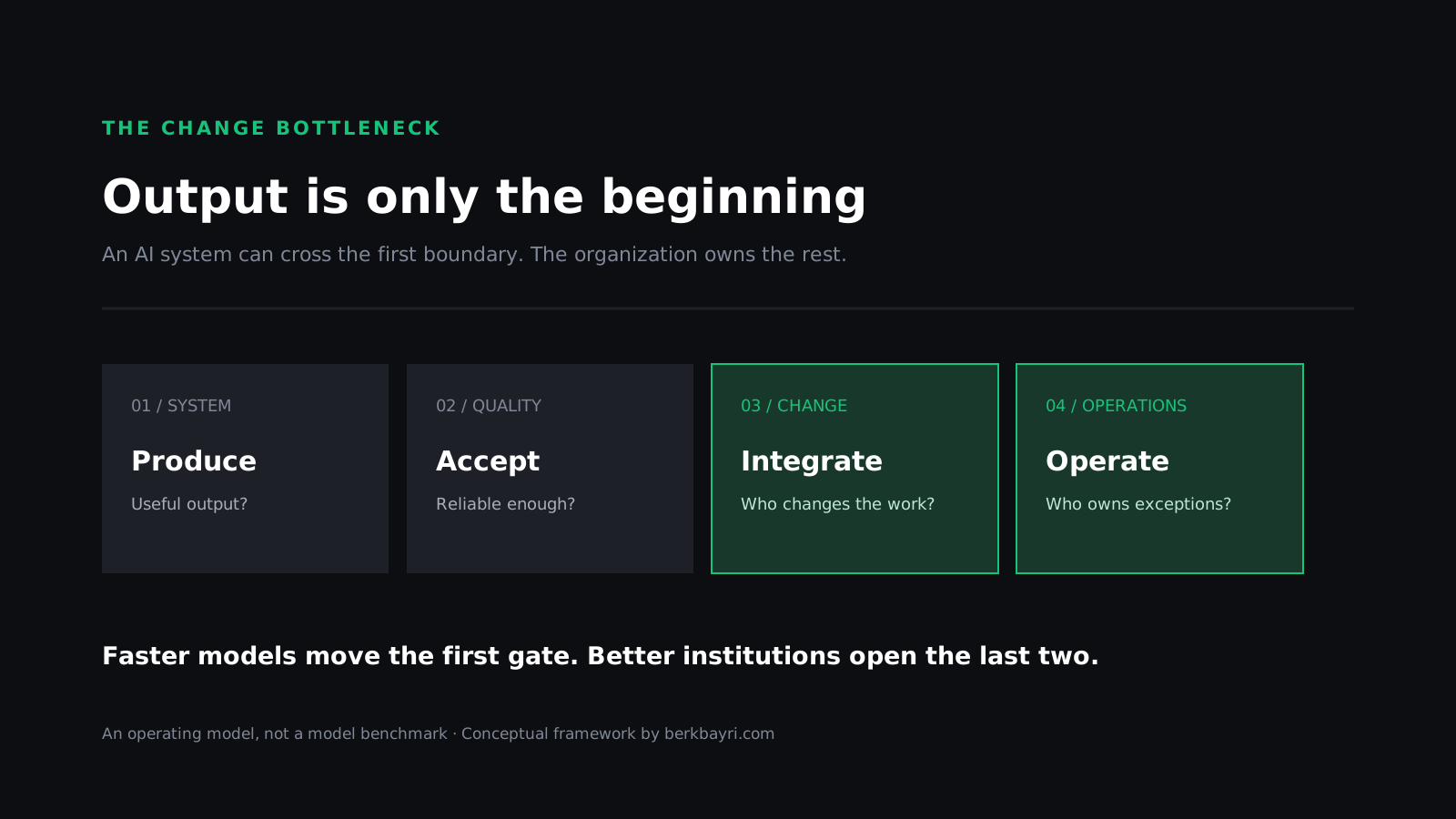
This is an editorial operating model, not a validated four-stage maturity scale. Its purpose is to let a leadership team see where work has stopped moving.
If output production increases while accepted work remains flat, investigate quality, missing context or evaluation overhead. If accepted work rises while operating decisions remain unchanged, look for the owner who can actually change the workflow. If the first pilot team must rescue every exception, the organization has put something into production without fully building the ability to run it.
That last problem is related to something I explored in the second-team test for innovation. There, the question was whether another competent team could reproduce a pilot's success without inheriting its founders' exceptional knowledge. Here the unit of analysis is larger. Can the organization itself digest the volume of change its AI program is generating, while continuing to make promises it can keep?
An AI roadmap tells you how quickly new capability will arrive. It rarely tells you how quickly the company can change around it.
Absorption has a cost, and much of it is paid in attention
Every meaningful rollout makes demands on people who already have jobs.
Someone must decide which outputs are safe to accept. Someone must rewrite a procedure, adjust a performance measure, revise a contract, negotiate with a dependent team, explain a new exception policy or remove a redundant review. In many companies these activities do not have a dedicated budget. They land in the calendars of department heads, frontline managers, operational specialists and legal or security staff whose existing obligations continue.
It is tempting to call this resistance to change. Sometimes resistance is real. But another possibility is more uncomfortable: the organization has authorized more transformation than it has made room to perform.
Google's 2025 DORA research characterizes AI as an amplifier of an organization's existing strengths and weaknesses, in the particular context of software development.5 It is a useful analogy, not proof that every sector behaves identically. Better models can make an efficient delivery system more effective. They can also send more unfinished work into an overloaded review process.
This suggests a different resource question. Alongside model spend and engineering effort, where is the capacity for organizational change being allocated? How many operating decisions can this business realistically revise in a quarter? Which managers have time and authority to implement them? Which old activities will disappear so the new ones do not merely pile up?
A program that cannot answer those questions may have an AI budget but no credible budget for absorbing AI.
Measuring the delay is more useful than declaring a company “ready”
I would avoid turning this into another generic readiness questionnaire. Readiness is an attractive label because it sounds like a property the entire firm possesses. Actual absorption is local, temporal and dependent on the work being changed.
Look at one real workflow. Record when an AI output is produced, when it passes acceptance, when a different operating decision actually occurs and when the process can run without exceptional intervention. The elapsed time between those events is more revealing than the number of licenses activated. Watch the exceptions, too: how many decisions come back for human rescue, and what sort of rescue do they need?
These are proposed diagnostic measures, not established industry benchmarks. They should be interpreted alongside outcome quality and the costs of review. A highly regulated decision may appropriately take longer. Deliberate checks are not failure. The failure is to confuse unexamined delay with necessary control, or to let apparent throughput hide unresolved responsibility.
A 2026 study using nationally representative US business data also illustrates why adoption requires more than a yes-or-no label. It distinguishes firm-wide use, use by business function and use in individual worker tasks; among firms using AI, deployment was concentrated in relatively few functions.6 The finding does not tell us which of those firms will create durable value. It warns against reading an adoption count as evidence that change has spread through the operating model.
An honest absorption measure can also tell a company to slow down. A pilot may be technically successful yet require more supervisory effort than the receiving team can provide safely. Expanding it immediately does not demonstrate ambition. It increases exposure to an unresolved constraint.
The strongest objection is that organizations can learn
Of course they can. The argument is not that companies have a fixed, natural limit on how much AI they can absorb. Capacity is something organizations can build.
The 2025–26 research presents a useful tension. Danish administrative-data evidence found substantial chatbot adoption and task reorganization, but no detectable average effect on recorded hours or earnings at the worker or workplace level over the study's early observation window.7 That is not a verdict that AI produces no value. It shows why structural changes, distribution of benefits and the time required for effects to emerge must be distinguished from immediate user enthusiasm.
The constructive response is to make change itself part of the investment. Assign a permanent operating owner before declaring a pilot finished. Give that owner authority to retire an obsolete step. Fund the evaluation work, the data repair, the exception handling and the redesign of measures that will otherwise sit outside the project. Sequence rollout around the ability of teams to take responsibility rather than around the next model milestone.
There is a choice here that deserves to be made explicitly. You can deploy the same AI feature everywhere and spread the resulting operating debt. Or you can make fewer, more consequential changes and ensure that each one leaves behind a capability that the next team can inherit. The second path may create less impressive adoption charts and a more capable organization.
The question for the next budget meeting
Ask the technical team what AI can do. They should know, and you should want them to discover more. But once a capability has cleared a credible performance threshold, that question stops being sufficient.
Ask the people who run the business what must change for the capability to matter. Listen for answers about decisions, ownership, systems of record, staffing, exceptions, customer promises and old work that needs to end. If those answers are missing, the gap is not simply a communications problem between the AI team and everyone else. It is the investment problem.
The previous wave of enterprise software taught companies to budget for implementation. AI should teach them to budget for absorption: for the time and authority required to turn a new technical possibility into an ordinary way of working.
The model's next release may be ready before your company is. That is not a reason to stop learning what it can do. It is a reason to be much more precise about what your company can take on.
Sources and evidence notes
Footnotes
-
Eleanor W. Dillon, Sonia Jaffe, Nicole Immorlica and Christopher T. Stanton, Shifting Work Patterns with Generative AI, NBER Working Paper 33795, May 2025, revised November 2025. Six-month randomized field experiment across 66 firms and 7,137 workers. The email time reduction pertains to users in the latter half; absence of detected task-composition shifts is not proof that no company benefited. ↩
-
Erik Brynjolfsson, Danielle Li and Lindsey R. Raymond, Generative AI at Work, NBER Working Paper 31161 (2023), subsequently Quarterly Journal of Economics (2025). Customer-support setting; findings are not an all-industry productivity estimate. ↩
-
Wesley M. Cohen and Daniel A. Levinthal, Absorptive Capacity: A New Perspective on Learning and Innovation, Administrative Science Quarterly 35(1), 1990. Original organizational-learning construct, not an AI-specific measurement framework. ↩
-
OECD/BCG/INSEAD, The Adoption of Artificial Intelligence in Firms: New Evidence for Policymaking, 2 May 2025. Mixed enterprise survey/interview and policy evidence, with its own sample boundaries. ↩
-
Google Cloud DORA, State of AI-assisted Software Development 2025. Findings address software teams, and their transfer to other operating contexts is an analogy. ↩
-
Kathryn Bonney and colleagues, The Microstructure of AI Diffusion: Evidence from Firms, Business Functions, and Worker Tasks, NBER Working Paper 35141, April 2026. US Census Bureau BTOS AI supplement, November 2025–January 2026. ↩
-
Anders Humlum and Emilie Vestergaard, Still Waters, Rapid Currents: Early Labor Market Transformation under Generative AI, NBER Working Paper 33777, revised March 2026. Danish early-labor-market study; no detectable average hours/earnings effect is not the same as zero benefit. ↩