The biggest AI mistake companies make is starting with AI
An AI-first mandate can turn discovery into justification. The missing discipline is preserving the right to choose a better, simpler answer.
The problem with an AI-first mandate is not enthusiasm for a powerful technology. It is committing to an answer before the organization has earned the right to choose one.
A leadership team announces that the company needs to become AI-first. Business units are asked for use cases. Teams rank ideas by feasibility, savings and speed to pilot. A steering committee creates a roadmap. Everything looks disciplined, except for one decision nobody has examined: whatever problem we discover, the answer should involve AI.
That does not guarantee a bad project. It makes the better choice harder to recognize.
If the solution is fixed before discovery begins, discovery becomes an exercise in justification.
The mandate changes what the company is allowed to find
Exploring AI capabilities before a precise use case exists is legitimate. Prototypes can reveal products, workflows and markets nobody had imagined. But capability exploration and investment selection are different activities. The first buys information about what is possible. The second allocates scarce money and organizational capacity to a consequential business outcome.
When every function must submit AI use cases, teams begin describing problems in ways that fit the technology. A policy change, a simpler form, clearer ownership, a conventional rules engine or the removal of an approval may never enter the competition. The backlog becomes a map of problems that survived an AI-shaped filter, not a neutral map of business opportunity.
RAND's 2024 qualitative study of experienced AI practitioners identifies leadership misunderstanding the business problem as a recurring failure cause. In its industry interviews, 84% of participants cited at least one leadership-driven cause among the main reasons projects fail. That is a share of interviewees discussing causes, not an 84% project failure rate.1
The UK government's 2025 AI playbook makes the practical rule explicit: identify opportunities from business and user needs, and remain open to established technologies being the better solution.2 The strategic mistake is not using AI. It is excluding alternatives before evaluating them.
Compare AI with the strongest alternative, not a straw man
Imagine a company where disputed refunds take five days. Leadership proposes an AI agent to read case histories, recommend decisions and prepare approval records. Yet if the delay comes from mandatory signatures or an unowned queue, the agent prepares documents that still wait. Changing policy or ownership may deliver more value with less risk.
That is an illustrative scenario, not a reported case study. It exposes the missing question: what would we do to achieve the same result without AI?
Every serious AI investment should face three credible options: an AI-enabled intervention, including its supervision, security and recovery costs; a non-AI intervention, including process, policy or conventional software changes; and deferring or not building, including the opportunity cost of waiting. Deferral preserves capacity for other work.
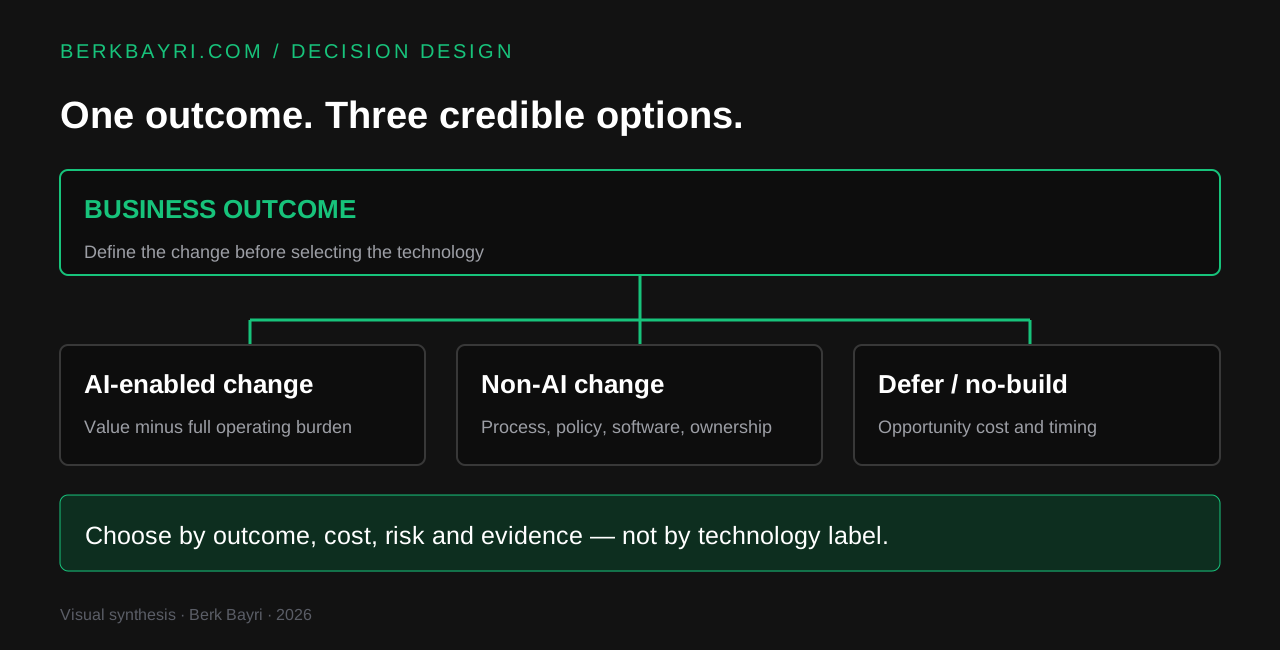
A sponsor should be able to name the strongest non-AI alternative and explain why AI should beat it. Otherwise the investment decision is premature.
Exploration is a legitimate exception: a small, explicitly exploratory budget can test capabilities before a business case exists. But exploration buys learning, while transformation funding buys an outcome. Do not ask a learning experiment to invent ROI, or excuse an investment from comparison because it is labelled innovation. OpenAI Academy's September 2026 sequencing worksheet similarly begins investment selection with a business priority and leadership decision; it is vendor guidance, not independent evidence.3
Five lines before the first model call
Before committing serious delivery capacity, require a five-line brief: Outcome—which business result must change, by how much and when? Constraint—what actually prevents it today? Alternatives—what is the strongest non-AI solution and credible defer option? Discriminating test—what observation would make AI preferable after full operating costs and risks? Owner and stop rule—who can authorize the change and what evidence would end the project?
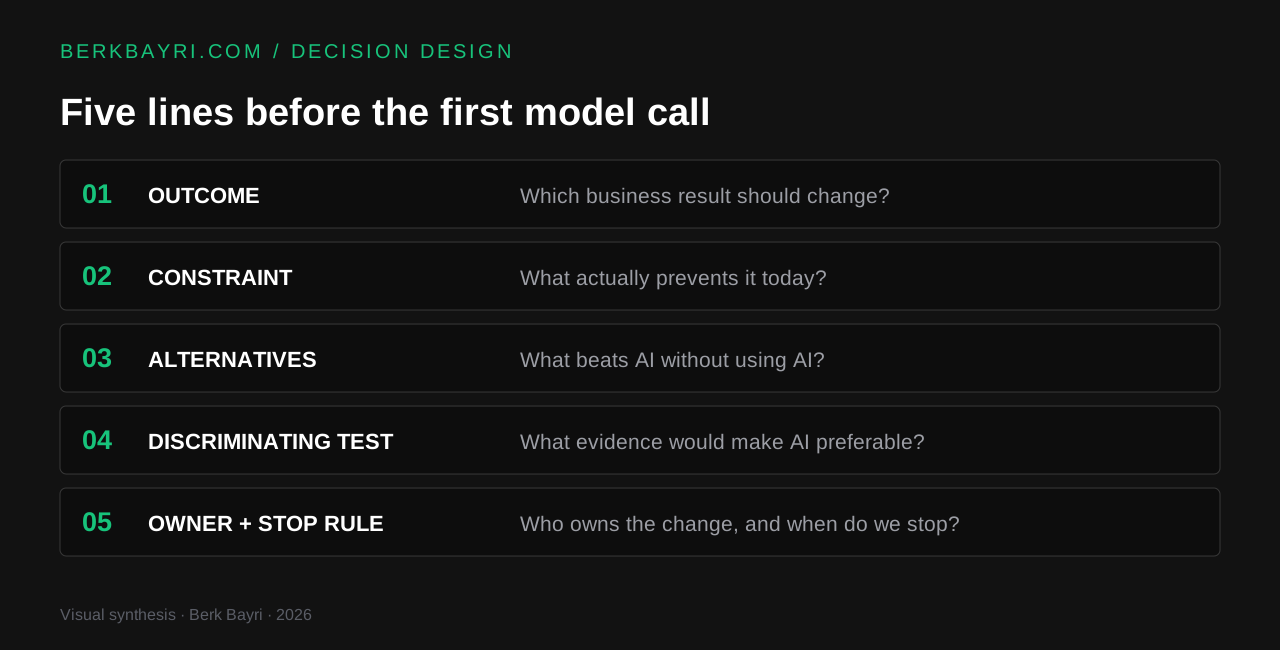
This is not a substitute for security, privacy or technical assessment. It prevents those expensive assessments from being applied to a solution that may never have been the right candidate.
The argument in Stop Adopting AI concerns the unit of organizational change. Your AI program can be efficient and still be strategically irrelevant concerns portfolio relevance after a use case works. This question comes earlier: which alternatives were allowed to compete before the use case was chosen?
A strong AI leader protects the freedom to explore new capabilities and the freedom to reject them. Sometimes the clearest evidence of strategy is a sentence the AI team can say without embarrassment: “We compared the alternatives. AI is not the best answer to this problem.”
Sources and evidence notes
Footnotes
-
RAND, The Root Causes of Failure for Artificial Intelligence Projects and How They Can Succeed, 2024; qualitative interviews, not a population failure-rate study. https://www.rand.org/content/dam/rand/pubs/research_reports/RRA2600/RRA2680-1/RAND_RRA2680-1.pdf ↩
-
UK Government Digital Service, Artificial Intelligence Playbook for the UK Government, 10 February 2025; normative guidance. https://www.gov.uk/government/publications/ai-playbook-for-the-uk-government/artificial-intelligence-playbook-for-the-uk-government-html ↩
-
OpenAI Academy, AI opportunity sequencing worksheet, updated 28 September 2026; vendor-authored guidance. https://academy.openai.com/en/public/clubs/champions-ecqup/resources/ai-opportunity-sequencing-worksheet-2026-07-29 ↩